
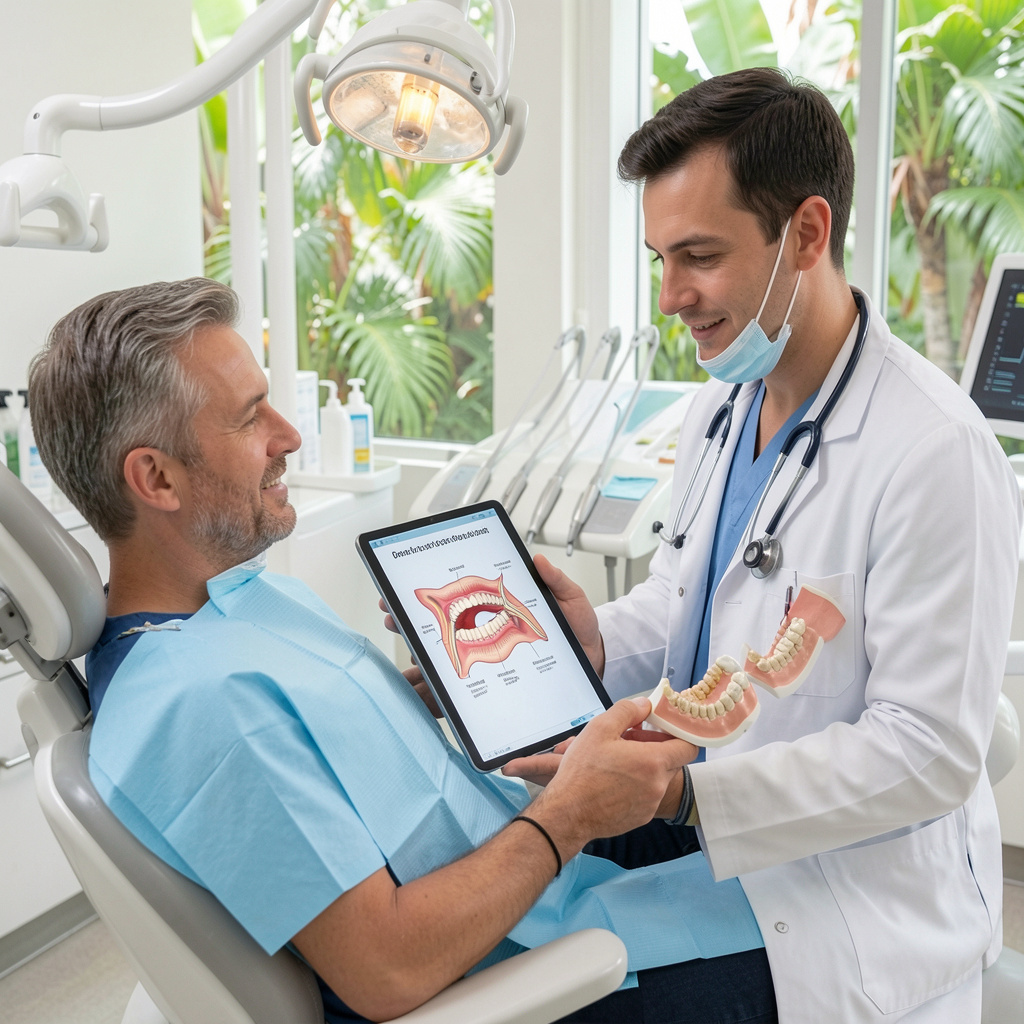
Bruxism and sleep apnoea can be connected, although teeth grinding does not automatically mean you have a sleep breathing disorder. Some people grind or clench because of stress, medication, bite issues or jaw muscle activity, while others may grind during sleep around breathing interruptions linked with obstructive sleep apnoea. The safest approach is to assess both the teeth and the airway rather than simply making a night guard and hoping the problem goes away.
At Cairns Family & Cosmetic Dental Group, we often see the dental signs of night-time grinding before patients realise their sleep may also be involved. This guide explains the link between teeth grinding and sleep apnoea, warning signs to watch for, how sleep bruxism is assessed, when a sleep study may be needed, and how dental appliances may fit into a team-based treatment plan.
Quick Answers About Bruxism and Sleep Apnoea
Are bruxism and sleep apnoea connected?
They can be connected in some patients, but the relationship is not simple. Research has found that sleep bruxism and obstructive sleep apnoea can occur together, yet not every person who grinds has sleep apnoea and not every person with sleep apnoea grinds their teeth.
Can teeth grinding be a sign of sleep apnoea?
Yes, teeth grinding and sleep apnoea can overlap, especially when grinding happens with loud snoring, waking gasping, morning headaches, dry mouth or daytime tiredness. Healthdirect explains that obstructive sleep apnoea can cause loud snoring, breathing pauses and daytime tiredness, which are important symptoms to discuss with a GP.
Can a dentist diagnose sleep apnoea from worn teeth?
No. Worn teeth can be a clue, not a diagnosis. The Australian Dental Association states that sleep apnoea must first be diagnosed by an appropriate medical practitioner, while dentists are qualified to manage oral appliance therapy when required.
Is a night guard enough if I grind my teeth?
Sometimes a night guard can protect teeth from grinding damage, but it may not treat an airway problem. If jaw clenching sleep apnoea symptoms are present, a sleep assessment may be needed before choosing the right appliance.
What should I do if I grind my teeth and snore?
Book a dental assessment and speak with your GP about sleep symptoms. A dentist can assess tooth wear, jaw muscles and appliance suitability, while a medical practitioner can arrange testing for obstructive sleep apnoea if needed.
What Is Bruxism?
Bruxism is clenching, grinding or bracing of the teeth and jaw muscles. It can happen while awake or during sleep.
Awake bruxism
Awake bruxism often involves jaw tension, clenching or holding the teeth together during the day. It may be linked with stress, concentration, posture, pain, anxiety or certain habits.
Sleep bruxism
Sleep bruxism happens during sleep and may involve rhythmic or non-rhythmic jaw muscle activity. Patients often do not know they are doing it unless a partner hears grinding sounds, or a dentist notices worn, chipped or cracked teeth.
Common signs of bruxism include:
- Worn, flattened or chipped teeth
- Cracked fillings or crowns
- Tooth sensitivity
- Jaw soreness on waking
- Morning headaches
- Tight facial muscles
- Clicking or painful jaw joints
- Ear-area discomfort
- Broken dental restorations
- Tongue or cheek ridging from pressure
A patient might come in saying, “I think I need a night guard because I keep breaking fillings.” That may be true, but we also want to ask why the grinding is happening and whether sleep quality, snoring or breathing pauses are part of the picture.
What Is Obstructive Sleep Apnoea?
Obstructive sleep apnoea, often shortened to OSA, happens when the upper airway partly or completely blocks during sleep. Breathing may stop briefly, oxygen levels may fall, and the brain may wake the body enough to reopen the airway. The person often does not remember these brief awakenings.
Healthdirect explains that OSA occurs when the airway is partly or completely blocked while asleep, causing short breathing pauses and repeated arousals through the night.
Common OSA symptoms include:
- Loud snoring
- Pauses in breathing noticed by a partner
- Waking up choking or gasping
- Tossing and turning
- Dry mouth
- Morning headaches
- Daytime sleepiness
- Feeling unrefreshed after sleep
- Irritability
- Poor concentration or memory problems
Untreated OSA can affect more than sleep. Healthdirect notes that untreated obstructive sleep apnoea can increase the risk of high blood pressure, heart rhythm problems, coronary heart disease, heart failure, stroke, diabetes, poor memory, concentration problems and accidents.
How Are Bruxism and Sleep Apnoea Connected?
Short answer
Bruxism and sleep apnoea may be connected because airway obstruction can trigger brief arousals from sleep, and jaw muscle activity may occur around these arousals. In some patients, grinding may be part of the body’s response to disrupted breathing. In others, the two conditions may simply occur together without one clearly causing the other.
The airway theory
One theory is that when the airway narrows during sleep, the body briefly activates muscles to reopen it. This may include jaw and tongue muscle activity. Some patients may clench or grind around these breathing events.
This does not mean grinding is always protective or always caused by sleep apnoea. It means that when bruxism appears with snoring, gasping, fatigue or morning headaches, the airway should be considered.
The arousal theory
Sleep apnoea causes repeated brief awakenings, called arousals. Bruxism episodes can also happen around arousals. This shared timing may partly explain why sleep bruxism and obstructive sleep apnoea are sometimes seen together.
The shared risk factor theory
Bruxism and OSA may also share risk factors, including:
- Stress
- Poor sleep quality
- Alcohol use
- Smoking
- Certain medications
- Reflux
- Jaw and airway anatomy
- Age
- Weight changes
- Other sleep disorders
This is why a careful assessment is better than assuming one simple cause.
What Does Research Say About Sleep Bruxism and Sleep Apnoea?
The research is mixed, which is important for trustworthiness. Some studies show an association between sleep bruxism and OSA, while others suggest the relationship is still uncertain.
A 2019 polysomnographic study of 110 adults found that OSA and sleep bruxism commonly co-occurred in the study group, and that the relationship depended on OSA severity. The study reported that OSA was correlated with sleep bruxism in mild and moderate OSA cases among patients at increased risk of OSA.
However, a 2024 population-based survey published in the Australian Dental Journal did not find a significant correlation between self-reported current sleep bruxism and OSA-related symptoms. This shows why we should avoid saying that grinding always means sleep apnoea.
A balanced clinical takeaway is this: sleep bruxism can be a useful clue, especially when combined with snoring or fatigue, but diagnosis needs proper sleep assessment rather than guesswork.
Teeth Grinding and Sleep Apnoea: Symptoms That Overlap
Teeth grinding and sleep apnoea can produce similar morning symptoms, which can make the picture confusing.
| Symptom | Bruxism | Sleep Apnoea | Why It Matters |
| Morning headaches | Common | Common | Can reflect jaw muscle strain or poor oxygen/sleep fragmentation |
| Jaw soreness | Common | Possible | Grinding may be primary or linked with arousals |
| Worn teeth | Common | Possible | OSA does not directly wear teeth, but bruxism may co-exist |
| Dry mouth | Possible | Common | Mouth breathing and snoring can contribute |
| Daytime tiredness | Possible | Common | Poor sleep quality may be involved |
| Loud snoring | Not typical | Common | Strong reason to discuss sleep testing |
| Waking gasping | Not typical | Common | Needs medical assessment |
| Broken restorations | Common | Possible | Heavy clenching can damage dental work |
A dental appointment can identify the damage pattern. A sleep assessment can help identify whether airway obstruction is also present.
Jaw Clenching Sleep Apnoea: When Should You Be Concerned?
Jaw clenching alone does not prove sleep apnoea. But jaw clenching sleep apnoea concerns become stronger when clenching appears with other sleep breathing symptoms.
Ask about sleep apnoea if you notice:
- Loud snoring
- Pauses in breathing during sleep
- Waking up choking or gasping
- Morning headaches
- Dry mouth every morning
- Daytime sleepiness
- High blood pressure
- Poor concentration
- Waking unrefreshed
- A partner saying your sleep sounds “interrupted”
- Grinding so strong that teeth, fillings or crowns are breaking
Healthdirect advises people to see their doctor if they or someone close to them is concerned about possible obstructive sleep apnoea.
Can a Night Guard Make Sleep Apnoea Worse?
This is a common and sensible question.
A standard night guard is usually made to protect teeth from grinding. It does not usually move the jaw forward to help the airway. In some patients, a poorly designed or bulky appliance may change tongue space or jaw position in a way that is not ideal for breathing.
That does not mean night guards are unsafe for everyone. It means that if you grind and also snore, wake gasping, feel exhausted or have suspected OSA, the dentist should ask more questions before making a simple splint.
At Cairns Family & Cosmetic Dental Group, we assess tooth wear, bite forces, jaw joints and symptoms before recommending an appliance. Our advanced dental technology supports careful dental assessment and treatment planning, including modern imaging and clinical systems that help us understand the condition of your teeth and supporting structures.
Bruxism Splint vs Sleep Apnoea Dental Appliance
A bruxism splint and a sleep apnoea dental appliance are not the same thing.
| Appliance Type | Main Purpose | How It Works | Best Suited For |
| Bruxism splint or night guard | Protects teeth from grinding wear | Creates a protective surface between teeth | Tooth grinding without suspected airway issue |
| Mandibular advancement splint | Helps support airway opening | Gently holds the lower jaw forward | Snoring, mild to moderate OSA, selected CPAP-intolerant patients |
| CPAP | Keeps airway open with air pressure | Delivers pressurised air through a mask | Many moderate to severe OSA cases |
| Combination approach | Manages both tooth protection and airway | Depends on diagnosis and appliance design | Patients with both bruxism and OSA |
The ADA states that oral appliances may be a first-line option for adults with snoring and mild to moderate OSA, and may also be indicated for people with severe OSA who are not compatible with CPAP therapy.
The key is choosing the right appliance for the right diagnosis.
How Dentists Assess Sleep Bruxism
A dental assessment for sleep bruxism may include:
- Checking tooth wear patterns
- Looking for chipped enamel
- Checking cracked fillings or crowns
- Assessing gum recession or tooth sensitivity
- Examining jaw muscles
- Checking jaw joint movement
- Asking about morning headaches
- Asking about stress and daytime clenching
- Asking about snoring and sleep quality
- Reviewing medications and medical history
- Looking for signs of dry mouth or mouth breathing
A dentist may also ask whether a partner has noticed grinding sounds, snoring, choking or breathing pauses.
At Cairns Family & Cosmetic Dental Group, our role is to protect the teeth, assess the jaw and guide patients toward medical assessment when airway symptoms appear. We do not diagnose sleep apnoea from tooth wear alone.
How Sleep Apnoea Is Diagnosed
Sleep apnoea diagnosis belongs with a medical practitioner. Your GP may ask about symptoms, examine your throat and nose, check blood pressure and refer you for a sleep study.
Healthdirect explains that a doctor may refer patients to a sleep clinic for an overnight sleep study, and that some people may be able to have a home sleep study. During a sleep study, breathing and oxygen levels are monitored while sleeping.
A sleep study may measure:
- Breathing pauses
- Oxygen levels
- Heart rate
- Snoring
- Body position
- Sleep stages, in more detailed studies
- Arousals from sleep
- Leg or body movements
The results help determine whether OSA is mild, moderate or severe, and whether CPAP, an oral appliance or another treatment may be appropriate.
Treatment Options When Bruxism and Sleep Apnoea Occur Together
When bruxism and sleep apnoea occur together, treatment should be planned carefully. The goal is not only to stop tooth damage, but also to manage the airway and sleep quality.
1. CPAP therapy
CPAP uses continuous positive airway pressure to keep the airway open during sleep. It is commonly used for moderate to severe OSA and can be highly effective when worn consistently.
If OSA is driving arousals that trigger jaw muscle activity, improving breathing may also reduce some grinding episodes in some patients. However, tooth wear may still need dental protection.
2. Mandibular advancement appliance
A mandibular advancement appliance gently holds the lower jaw forward during sleep. This can help keep the airway more open in selected patients.
The ADA says medical and dental expertise are both needed for oral appliance therapy, with medical expertise required to determine whether the therapy is indicated and effective, and dental expertise needed to assess dental suitability and manage orofacial complications.
3. Bruxism splint
A bruxism splint may help protect teeth from wear, chipping and cracking. It may be suitable when sleep apnoea is not suspected or has been ruled out.
4. Restorative dental care
If grinding has already damaged teeth, treatment may include:
- Composite bonding
- Crowns
- Replacement fillings
- Repair of chipped teeth
- Management of sensitivity
- Bite review
- Monitoring cracks
- Gum and enamel protection
Restorative work should be carefully planned if bruxism is still active, because heavy clenching can damage new dental work.
5. Stress and habit management
Stress does not explain every case of sleep bruxism, but it can play a role. Daytime clenching awareness, relaxation techniques, exercise, counselling, sleep routines and reducing stimulants may help some patients.
6. Lifestyle and medical care for OSA
Healthdirect lists OSA self-care measures such as losing weight if overweight, quitting smoking, avoiding alcohol or medicines that affect sleep, managing blocked nose symptoms and maintaining good sleep habits.
What Happens at a Dental Visit for Grinding and Possible Sleep Apnoea?
A visit may include both dental and sleep-related questions.
Step 1: We listen to your symptoms
We may ask:
- When did you notice grinding?
- Do you wake with jaw pain?
- Does anyone hear you grind?
- Do you snore?
- Has anyone noticed breathing pauses?
- Do you wake gasping?
- Do you wake with headaches?
- Are you tired during the day?
- Do you use CPAP?
- Have you had a sleep study?
Step 2: We check the teeth and bite
We look for worn enamel, cracks, chipped teeth, gum changes, tooth mobility, bite pressure and dental restorations that may be under strain.
Step 3: We assess jaw muscles and joints
Jaw clenching can strain the muscles and temporomandibular joints. We may check jaw opening, tenderness, clicking, locking or pain.
Step 4: We discuss whether medical sleep assessment is needed
If symptoms suggest possible OSA, we may recommend discussing sleep testing with your GP. This is especially important if snoring, gasping, daytime tiredness or high blood pressure are present.
Step 5: We discuss appliance options
If a dental appliance is appropriate, we explain the difference between a protective night guard and a mandibular advancement device. The choice depends on diagnosis, dental suitability and medical advice.
Patients can also meet our dentists to learn more about our team’s approach to comfortable, personalised care across general, restorative and dental sleep-related concerns.
Why a “One-Size-Fits-All” Mouthguard Is Not Enough
A generic mouthguard may seem like a quick fix, but grinding and sleep breathing problems need more care.
A generic device may:
- Fit poorly
- Cause jaw soreness
- Increase tooth pressure
- Fail to protect all teeth evenly
- Fall out during sleep
- Feel bulky
- Miss signs of OSA
- Delay proper diagnosis
- Worsen discomfort if the jaw is placed poorly
If you have tooth grinding without sleep apnoea symptoms, a custom dental splint may be enough. If you have grinding plus snoring, gasping or daytime fatigue, a sleep-focused pathway is safer.
Real-World Examples
Example 1: Grinding without sleep symptoms
A patient has worn front teeth and reports daytime stress. They do not snore, do not wake gasping and feel refreshed in the morning. A protective splint, stress management and monitoring may be appropriate.
Example 2: Grinding with snoring and fatigue
A patient has cracked molars, morning headaches and loud snoring. Their partner has noticed breathing pauses. In this case, we would not simply make a night guard without recommending medical review for possible sleep apnoea.
Example 3: Confirmed OSA and tooth wear
A patient has diagnosed moderate OSA and uses CPAP, but still clenches heavily. Dental care may focus on protecting teeth and repairing damage while their sleep physician manages airway treatment.
Example 4: CPAP intolerance and jaw clenching
A patient has confirmed OSA but cannot tolerate CPAP. After medical review, a mandibular advancement appliance may be considered if their teeth, gums and jaw joints are suitable.
Risks of Ignoring Bruxism
Untreated bruxism can damage the mouth over time.
Possible dental risks include:
- Enamel wear
- Tooth sensitivity
- Chipped teeth
- Cracked teeth
- Broken fillings
- Damaged crowns
- Gum recession
- Tooth mobility
- Jaw muscle pain
- Headaches
- Temporomandibular joint symptoms
The longer grinding continues, the more complex repair can become. Protecting teeth early can reduce the risk of more involved restorative treatment later.
Risks of Ignoring Sleep Apnoea
Ignoring possible sleep apnoea can affect more than your teeth. Poor sleep and repeated breathing interruptions can affect daily function and long-term health.
Healthdirect lists possible complications of untreated OSA, including high blood pressure, heart arrhythmias, coronary heart disease, heart failure, stroke, diabetes, poor concentration, mood changes and increased risk of car or workplace accidents.
If you grind and also have OSA symptoms, treating only the teeth may leave the underlying sleep breathing issue unmanaged.
How to Talk to Your GP About Teeth Grinding and Sleep Apnoea
It helps to be specific. Instead of saying, “I sleep badly,” mention exact symptoms.
Tell your GP if you have:
- Loud snoring
- Witnessed breathing pauses
- Waking gasping or choking
- Morning headaches
- Daytime sleepiness
- High blood pressure
- Dry mouth
- Teeth grinding noticed by a dentist or partner
- Jaw soreness on waking
- Poor concentration
Ask whether a sleep study may be appropriate.
Questions to Ask Your Dentist
Before getting a splint or appliance, ask:
- Is my tooth wear consistent with grinding?
- Do I show signs of jaw clenching?
- Could my symptoms suggest sleep apnoea?
- Should I speak with my GP before getting a night guard?
- Is a bruxism splint or mandibular advancement appliance more suitable?
- Are my teeth and gums healthy enough for an appliance?
- Could an appliance affect my jaw joints or bite?
- How often will I need reviews?
- What damage already needs repair?
- How do I clean and care for the appliance?
Quick Answers and FAQ
Can sleep apnoea cause teeth grinding?
Sleep apnoea may contribute to teeth grinding in some patients, possibly through airway-related arousals and jaw muscle activity. The relationship is not proven in every case, so diagnosis needs proper dental and medical assessment.
Is jaw clenching a sign of sleep apnoea?
Jaw clenching can be one sign, especially if it occurs with snoring, gasping, morning headaches or daytime tiredness. On its own, clenching can also be related to stress, habits, medications or jaw muscle tension.
Should I get a night guard if I snore?
Not without discussing sleep symptoms first. If you snore loudly or have possible OSA symptoms, speak with your GP and dentist so the correct appliance is chosen.
Can a mandibular advancement splint help both bruxism and sleep apnoea?
In suitable patients, a mandibular advancement splint may help support the airway while also covering and protecting the teeth. It must be professionally fitted and monitored.
Can Cairns Dental help with bruxism and sleep apnoea concerns?
Yes. We can assess tooth wear, jaw muscles, bite and appliance suitability, and we can guide you toward medical sleep assessment when symptoms suggest possible OSA.
Why Choose Cairns Family & Cosmetic Dental Group?
Cairns Family & Cosmetic Dental Group provides dental care across Earlville and Mt Sheridan, with a focus on comfortable, practical and personalised care for local families. If you are concerned about grinding, worn teeth, jaw pain, snoring or possible sleep-related dental signs, we can assess the dental side and help you understand the next steps.
Our role is not to diagnose sleep apnoea from the dental chair. Our role is to recognise oral signs, protect teeth, assess appliance suitability and work within the right medical pathway. That distinction matters because bruxism and sleep apnoea often need both dental and medical input.
Conclusion: Should You Be Concerned About Bruxism and Sleep Apnoea?
Bruxism and sleep apnoea can overlap, especially when teeth grinding appears with loud snoring, waking gasping, dry mouth, morning headaches or daytime fatigue. Grinding alone does not prove obstructive sleep apnoea, but it can be an important clue that your sleep and airway deserve closer attention.
A standard night guard may protect teeth, but it may not treat an airway problem. If sleep apnoea is suspected, medical assessment and sleep testing should come first. If oral appliance therapy is appropriate, a dentist can assess whether your teeth, gums, bite and jaw joints can support a custom appliance.
At Cairns Family & Cosmetic Dental Group, we can help assess tooth wear, jaw clenching, cracked restorations and appliance suitability. Contact our Cairns team to book a consultation and discuss your options.