
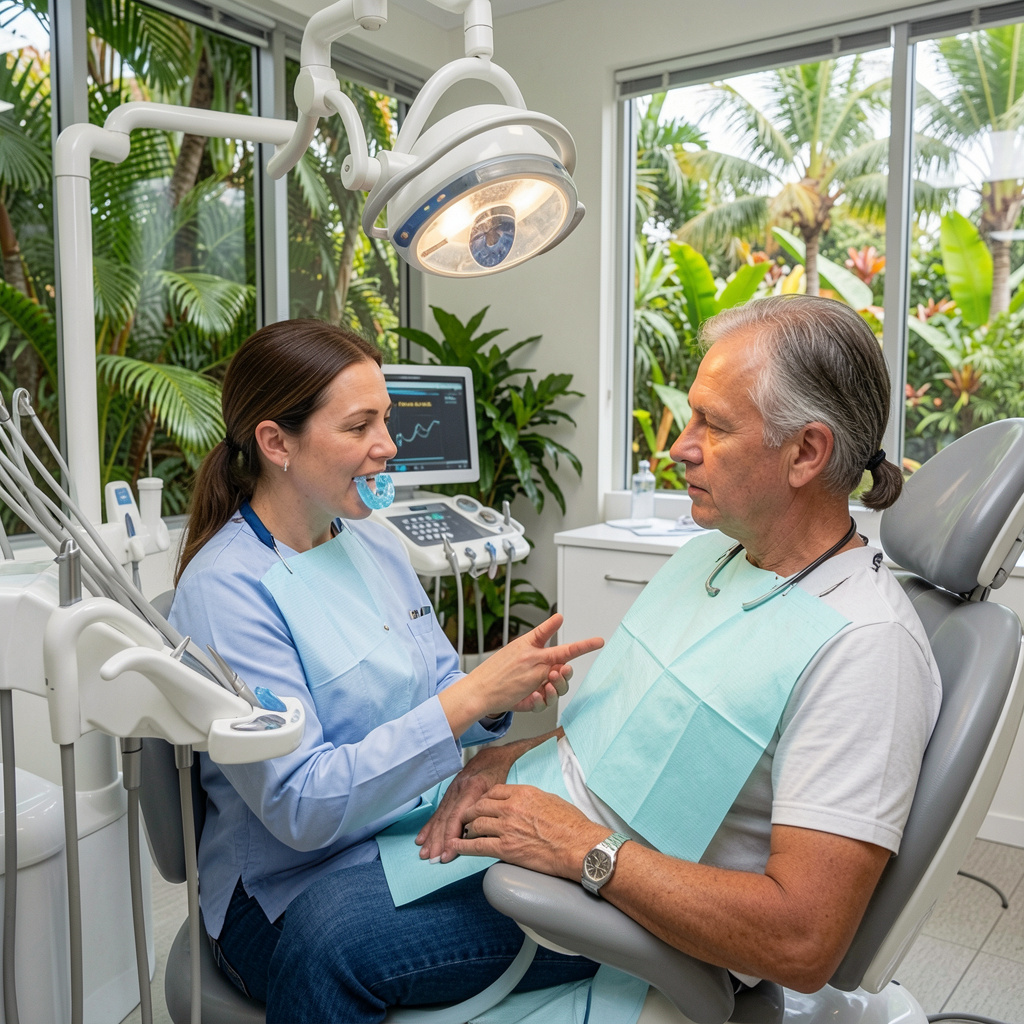
A sleep apnoea mouth guard is a custom dental appliance worn during sleep to help keep the airway open by gently moving the lower jaw forward. It may help adults with snoring, mild to moderate obstructive sleep apnoea, and some people with more severe sleep apnoea who cannot tolerate CPAP. It is not the same as a sports mouthguard or a basic night guard for grinding, and it should only be used after proper medical assessment.
At Cairns Family & Cosmetic Dental Group, we help patients understand whether a sleep apnoea dental appliance may suit their teeth, gums, jaw joints, bite and broader sleep treatment plan. This guide explains how mouth guards for sleep apnoea work, who may benefit, what sleep apnoea mouthguard cost Australia patients should expect, how mandibular advancement splints compare with CPAP, and what happens during the fitting process.
Quick Answers About Sleep Apnoea Mouth Guards
What is a sleep apnoea mouth guard?
A sleep apnoea mouth guard is usually a mandibular advancement splint or mandibular advancement device. It fits over the upper and lower teeth and gently holds the lower jaw forward while you sleep.
Does a sleep apnoea mouth guard really work?
Yes, it can work for selected patients. The Sleep Health Foundation explains that oral appliances can help treat snoring and mild or moderate obstructive sleep apnoea by pushing the lower jaw forward so the airway is more open.
Who can use a mandibular advancement splint for sleep apnoea?
A mandibular advancement splint may suit adults with snoring, mild to moderate obstructive sleep apnoea, or selected patients with more severe sleep apnoea who cannot use CPAP. The Australian Dental Association states that sleep apnoea must first be diagnosed by an appropriate medical practitioner, and that dental appliances should be managed by a dentist when required.
How much does a sleep apnoea mouthguard cost in Australia?
A custom sleep apnoea mouthguard cost Australia patients may see is often around $1,500 to $2,000 for a tailored mandibular advancement device, based on RACGP guidance. Cheaper boil-and-bite devices may cost less, but they are not the same as a custom dentist-managed appliance.
Can I buy a mouth guard online for sleep apnoea?
You can buy anti-snoring devices online, but they are not a substitute for medical diagnosis or a professionally fitted sleep apnoea dental appliance. A poorly fitted device may be uncomfortable, ineffective, or unsuitable for your condition.
What Is a Sleep Apnoea Mouth Guard?
A sleep apnoea mouth guard is a dental device worn at night to help reduce airway collapse. The more accurate names are:
- Mandibular advancement splint
- Mandibular advancement device
- Mandibular repositioning appliance
- Sleep apnoea dental appliance
- Oral appliance for obstructive sleep apnoea
Although many patients call it a mouth guard, it is very different from a sports mouthguard. A sports mouthguard protects teeth from impact. A grinding splint protects teeth from clenching. A sleep apnoea mouth guard is designed to change the position of the lower jaw during sleep.
When the lower jaw is held slightly forward, the tongue and soft tissues may also sit in a better position. This can help reduce narrowing at the back of the throat, making it easier for air to move through the upper airway.
The Sleep Health Foundation describes these appliances as devices that look a bit like a mouth guard and are worn only at night. They work by pushing the lower jaw forward so the airway opens more, reducing the risk of snoring vibration or obstruction.
Why Do People Search for a Sleep Apnoea Mouth Guard?
Most people search for a sleep apnoea mouth guard because they are looking for a practical alternative to CPAP, or because snoring has started affecting their sleep, partner or energy levels.
Common reasons include:
- Loud snoring
- Waking up gasping or choking
- Morning headaches
- Dry mouth on waking
- Daytime tiredness
- Difficulty concentrating
- A partner noticing breathing pauses
- CPAP mask discomfort
- Jaw tension or tooth grinding
- Wanting a smaller treatment option for travel
- Looking for a dentist-fitted sleep apnoea dental appliance
At Cairns Family & Cosmetic Dental Group, we often speak with patients who say, “I was told I snore,” or “I tried CPAP but I cannot keep the mask on.” A dental appliance may be helpful in some of these cases, but it should sit within a proper medical and dental care pathway.
Sleep Apnoea Mouth Guard Australia: What Are Your Options?
Patients searching for sleep apnoea mouth guard Australia options may see several types of devices. The differences matter.
| Type of Device | How It Works | Main Benefit | Main Limitation |
| Boil-and-bite device | Softened at home and shaped over the teeth | Low upfront cost | Less precise, bulky, may not treat OSA properly |
| Semi-tailored device | Impression is taken by the patient and sent away | More tailored than boil-and-bite | Less direct clinical supervision |
| Custom mandibular advancement splint | Dentist takes records and fits the appliance | Better fit, adjustability and monitoring | Higher upfront cost |
| Grinding night guard | Protects teeth from clenching | Useful for bruxism | Does not usually treat airway obstruction |
| CPAP | Uses air pressure through a mask | Highly effective when used consistently | Some patients find it hard to tolerate |
RACGP guidance describes mandibular advancement devices as an alternative to CPAP for obstructive sleep apnoea and lists boil-and-bite, semi-tailored and tailored device options. Tailored devices are custom-made by clinicians who work with oral appliances for OSA.
How Does a Mandibular Advancement Splint Help Sleep Apnoea?
A mandibular advancement splint sleep apnoea device works by gently positioning the lower jaw forward during sleep. This can help keep the airway more open.
Short answer
A mandibular advancement splint helps by reducing airway narrowing at night. It does not blow air into the airway like CPAP. Instead, it changes jaw and tongue position to improve airflow.
What happens during sleep?
When you fall asleep, the muscles around the throat relax. In some people, the airway narrows or collapses. This can cause snoring, reduced airflow, breathing pauses and repeated brief awakenings.
A mandibular advancement splint may help by:
- Moving the lower jaw forward
- Bringing the tongue forward with the jaw
- Reducing soft tissue collapse
- Improving airflow behind the tongue
- Reducing snoring vibration
- Reducing some breathing interruptions in suitable patients
Cairns Dental’s sleep information explains that custom fitted oral appliances gently position the lower jaw forward, helping prevent soft tissue collapse that can contribute to snoring and airway obstruction.
Is a Sleep Apnoea Mouth Guard the Same as a Night Guard?
No. A sleep apnoea mouth guard is not the same as a night guard for grinding.
A grinding night guard is designed to protect teeth from clenching and grinding. It usually does not move the jaw forward in a controlled way. A sleep apnoea dental appliance is designed to support airway opening by advancing the lower jaw.
| Device | Main Purpose |
| Sports mouthguard | Protects teeth during sport |
| Grinding splint | Protects teeth from clenching and grinding |
| Retainer | Holds teeth after orthodontic treatment |
| Mandibular advancement splint | Helps keep the airway more open during sleep |
| CPAP mask | Uses air pressure to keep the airway open |
This difference is important. If someone has obstructive sleep apnoea, wearing a basic night guard may protect the teeth but may not treat the breathing problem. In some patients, an unsuitable device can also affect jaw comfort or bite position.
Who Is a Good Candidate for a Sleep Apnoea Dental Appliance?
A sleep apnoea dental appliance may suit selected adults after a proper medical diagnosis and dental assessment.
You may be suitable if you:
- Have snoring or mild to moderate obstructive sleep apnoea
- Have been assessed by a GP or sleep physician
- Cannot tolerate CPAP
- Have enough healthy teeth to support the appliance
- Have stable gums
- Have jaw joints that can tolerate gentle forward positioning
- Want a portable option for travel
- Can attend follow-up appointments
- Can clean and maintain the appliance daily
The Australian Dental Association’s guidance on dental appliances for sleep-disordered breathing makes the team approach clear: sleep apnoea diagnosis belongs with an appropriate medical practitioner, while dental appliance therapy should be managed by a dentist.
You may need another option if you:
- Have central sleep apnoea
- Have severe OSA that needs CPAP as first-line care
- Have untreated gum disease
- Have very loose teeth
- Have too few teeth to hold the appliance
- Have significant jaw joint pain
- Cannot tolerate jaw advancement
- Have complex medical sleep issues
- Have not yet had a sleep study or medical diagnosis
A dentist can check whether your mouth can support the appliance, but your GP or sleep physician should guide diagnosis and medical treatment decisions.
Sleep Apnoea Mouthguard Cost Australia: What Should You Expect?
Sleep apnoea mouthguard cost Australia patients pay depends on the device type, complexity, dental records, adjustments, reviews and whether any private health fund rebates apply.
What affects the cost?
| Cost Item | What It Covers |
| Initial consultation | Dental assessment, symptoms discussion and appliance suitability |
| Records | Scans, impressions, bite registration and jaw position records |
| Appliance fabrication | Custom laboratory-made mandibular advancement splint |
| Fitting appointment | Checking retention, comfort and lower jaw position |
| Adjustments | Gradual changes to improve comfort and airway support |
| Reviews | Monitoring jaw joints, teeth, bite and appliance wear |
| Follow-up testing | Medical confirmation that treatment is helping, if recommended |
Why do custom appliances cost more than online devices?
A custom mandibular advancement splint costs more because it involves professional assessment, accurate dental records, appliance design, fitting, adjustment and follow-up. You are not only paying for the appliance itself. You are paying for a treatment process designed to protect your teeth, jaw joints and airway health.
RACGP guidance lists tailored mandibular advancement devices at approximately $1,500 to $2,000, with rebates available from some health insurers. It also notes that boil-and-bite and semi-tailored options can cost less, but those lower-cost options are not the same as a dentist-managed custom device.
Does private health insurance cover a sleep apnoea dental appliance?
Some extras policies may provide a rebate for oral appliances, but cover varies. Ask your health fund:
- Which item numbers apply?
- Is there a waiting period?
- What is my annual limit?
- Does my policy cover mandibular advancement devices?
- Is a sleep study or medical referral required?
Sleep Apnoea Mouth Guard vs CPAP: Which Is Better?
The best treatment depends on your diagnosis, OSA severity, medical history and what you can use consistently.
CPAP
CPAP uses continuous positive airway pressure through a mask to keep the airway open. It is often very effective, especially for moderate to severe obstructive sleep apnoea, but some patients struggle with mask fit, dryness, pressure, noise or travel convenience.
Sleep apnoea mouth guard
A sleep apnoea mouth guard is smaller, quiet and portable. It may suit patients with snoring, mild to moderate OSA, or selected patients who cannot tolerate CPAP.
The Sleep Health Foundation explains that CPAP stops sleep apnoea straight away in almost all people who use it, while an oral appliance usually improves sleep apnoea but may not completely stop it.
| Feature | CPAP | Sleep Apnoea Mouth Guard |
| How it works | Air pressure keeps the airway open | Lower jaw is held forward |
| Best suited for | Many moderate to severe OSA cases | Snoring, mild to moderate OSA, selected CPAP-intolerant patients |
| Portability | Machine, mask and tubing required | Small appliance in a case |
| Comfort | Some patients dislike the mask | Some patients feel jaw or tooth pressure |
| Maintenance | Clean mask, tubing and humidifier | Clean appliance and attend dental reviews |
| Effectiveness | Often highly effective when used consistently | Can improve OSA but may not fully control severe cases |
| Supervision | GP, sleep physician or CPAP provider | GP or sleep physician plus dentist |
What Happens Before Getting a Sleep Apnoea Mouth Guard?
A proper process helps make treatment safer and more effective.
Step 1: Medical assessment and sleep testing
You should not self-diagnose sleep apnoea based only on snoring. A GP or sleep physician may recommend a sleep study to confirm whether you have OSA and how severe it is.
The diagnosis matters because simple snoring, mild OSA, moderate OSA, severe OSA and central sleep apnoea can need different treatment plans.
Step 2: Dental assessment
Once oral appliance therapy is considered appropriate, the dentist checks whether your teeth, gums, jaw joints and bite can support a device.
A dental assessment may include checking:
- Tooth health
- Gum health
- Missing teeth
- Crowns, bridges or implants
- Bite position
- Jaw joint comfort
- Jaw range of movement
- Tooth grinding or clenching signs
- Tooth wear
- Oral hygiene
- Whether the appliance can stay securely in place
At Cairns Family & Cosmetic Dental Group, our advanced dental technology supports patient care with modern diagnostic and treatment planning systems. This can help us assess dental conditions that may affect appliance suitability.
Step 3: Records and bite registration
If you are suitable, the next step is to take accurate records. These may include digital scans, impressions, photographs and a bite registration that records the planned jaw position.
Step 4: Appliance fabrication
The appliance is made to fit your teeth and jaw. Depending on the design, it may allow gradual adjustment so the lower jaw can be moved forward in small increments.
Step 5: Fitting appointment
At the fitting appointment, we check:
- How the appliance seats on the teeth
- Whether it feels secure
- Whether there are pressure spots
- How far the lower jaw is positioned forward
- How to insert and remove the device
- How to clean and store it
- What side effects to watch for
Step 6: Adjustment period
The appliance is usually adjusted gradually. Moving the jaw too far too quickly can cause jaw discomfort, tooth pressure or bite changes. Small adjustments help balance airway support with comfort.
Step 7: Review and treatment monitoring
Follow-up matters. Your dentist checks the appliance, teeth, gums, bite and jaw joints. Your GP or sleep physician may recommend repeat sleep testing to confirm whether treatment is working.
The Sleep Health Foundation notes that follow-up visits with a dentist or sleep specialist are needed after an oral appliance is fitted.
Risks and Side Effects of a Sleep Apnoea Mouth Guard
A sleep apnoea mouth guard can be useful, but it is not risk-free. Most side effects are mild and manageable, but some need review.
Short-term side effects may include:
- Jaw soreness
- Tooth tenderness
- Gum irritation
- Extra saliva
- Dry mouth
- Morning bite changes
- Tightness in jaw muscles
- Difficulty getting used to the appliance
Longer-term risks may include:
- Tooth movement
- Bite changes
- Jaw joint discomfort
- Appliance wear or breakage
- Loosening around dental work
- Reduced effectiveness if weight or airway factors change
- Need for replacement over time
The Sleep Health Foundation states that long-term use can cause tooth movement, bite changes, and jaw joint or muscle problems, which is why regular dental check-ups are important.
The ADA also notes that long-term appliance use needs monitoring of jaw joint function and tooth movement.
Can I Buy a Sleep Apnoea Mouth Guard Online or From a Chemist?
You may find anti-snoring mouthguards online, in pharmacies or through direct-to-consumer brands. These may look similar to dental appliances, but they are not the same as a custom dentist-fitted mandibular advancement splint.
Over-the-counter devices may:
- Fit poorly
- Feel bulky
- Fall out during sleep
- Cause tooth pressure
- Cause jaw discomfort
- Fail to control OSA
- Delay proper diagnosis
- Give a false sense of safety
A major concern is that a person may stop at “I bought a snoring mouthguard” when they actually need a sleep study, CPAP, medical review or a custom dental appliance.
The Sleep Health Foundation states that over-the-counter dental devices are cheaper but usually do not work, and that a specially fitted appliance is preferred for better effect and fewer side effects.
Can a Sleep Apnoea Mouth Guard Help Snoring?
Yes, a properly fitted oral appliance may help reduce snoring in many people. Snoring often happens when soft tissues vibrate as air passes through a narrowed airway. By moving the lower jaw forward, a mandibular advancement splint may create more space and reduce vibration.
However, snoring should not be dismissed as harmless if it comes with:
- Breathing pauses
- Waking up gasping
- Morning headaches
- Dry mouth
- High blood pressure
- Daytime sleepiness
- Poor concentration
- Waking unrefreshed
If those symptoms are present, speak with your GP about sleep apnoea testing before choosing a device.
How Long Does a Sleep Apnoea Dental Appliance Last?
A custom sleep apnoea dental appliance may last several years, but its lifespan depends on the design, material, bite force, cleaning routine and whether you grind your teeth.
You can help your appliance last longer by:
- Cleaning it every morning
- Letting it dry before storing
- Keeping it away from pets
- Avoiding hot water unless instructed
- Bringing it to dental reviews
- Not adjusting it yourself unless shown how
- Telling your dentist if it feels loose, painful or worn
- Keeping your teeth and gums healthy
Heavy grinders may wear appliances faster. Changes in your teeth, bite or dental restorations can also affect the fit over time.
What If the Mouth Guard Stops Working?
If your snoring returns, daytime tiredness comes back, or your partner notices breathing pauses again, the appliance should be reviewed.
Possible reasons include:
- The device needs adjustment
- The appliance has worn down
- It is no longer fitting securely
- Your bite has changed
- Your weight has changed
- Your sleep apnoea has worsened
- Another sleep disorder is present
- The device is not being worn consistently
- You need repeat sleep testing
Do not keep using an uncomfortable or ineffective appliance without review. Sleep apnoea is a medical condition, and treatment should be monitored properly.
Real-World Examples From Dental Sleep Care
Example 1: Loud snoring with no diagnosis
A patient attends a routine dental visit and mentions that their partner complains about loud snoring. They also wake with a dry mouth. We cannot diagnose sleep apnoea in the dental chair, but we can recommend speaking with a GP about sleep testing.
Example 2: Mild OSA and CPAP not preferred
A patient has a sleep study showing mild obstructive sleep apnoea. They are not keen on CPAP and ask about a sleep apnoea dental appliance. We assess their teeth, gums and jaw joints, then discuss whether a custom mandibular advancement splint may be suitable.
Example 3: CPAP intolerance
A patient with moderate OSA has tried CPAP but removes it during sleep. Their sleep physician suggests oral appliance therapy as an alternative. We assess dental suitability and explain the fitting, adjustment and review process.
Example 4: Grinding and airway concerns
A patient has worn teeth and morning jaw tension. They ask for a simple night guard. During the appointment, they also mention snoring and daytime tiredness. A standard grinding splint may not be enough, so sleep testing may be needed before choosing the right appliance.
Questions to Ask Before Getting a Sleep Apnoea Mouth Guard
Before starting treatment, ask:
- Has my sleep apnoea been diagnosed by a medical practitioner?
- Is my OSA mild, moderate or severe?
- Is an oral appliance suitable for my case?
- Do I need CPAP instead, or alongside the appliance?
- Are my teeth and gums healthy enough?
- Could the device affect my jaw joints?
- Is the appliance adjustable?
- What is included in the cost?
- Will I need follow-up sleep testing?
- How often do I need dental reviews?
- What side effects should I watch for?
- What happens if the mouth guard does not work well enough?
Good treatment planning should answer these questions clearly.
Quick Answers and FAQ
What is the best mouth guard for sleep apnoea?
For most suitable patients, the best option is a custom mandibular advancement splint made and adjusted by a dentist, after medical diagnosis. Over-the-counter snoring devices may be cheaper but are not ideal for managing diagnosed sleep apnoea.
How much does a sleep apnoea mouthguard cost in Australia?
A tailored mandibular advancement device is often listed around $1,500 to $2,000 in RACGP guidance, while cheaper boil-and-bite devices may cost much less. Final fees depend on the provider, appliance type and follow-up required.
Is a sleep apnoea mouth guard better than CPAP?
Not always. CPAP is often more effective for moderate to severe OSA, while a mouth guard may suit snoring, mild to moderate OSA, or selected patients who cannot tolerate CPAP.
Can I use a normal night guard for sleep apnoea?
No. A normal night guard protects teeth from grinding but does not usually move the lower jaw forward or treat airway obstruction.
Do I need a sleep study before getting a mouth guard?
Yes, proper diagnosis is important. The ADA states that initial diagnosis of sleep apnoea must be made by an appropriate medical practitioner.
Why Choose Cairns Family & Cosmetic Dental Group?
Cairns Family & Cosmetic Dental Group provides dental care across Earlville and Mt Sheridan, with a focus on comfortable, practical care for local families. If you are concerned about snoring, jaw tension, tooth grinding or whether a mouth guard may help your sleep, our team can assess the dental side of your care.
You can also meet our dentists to learn more about our clinical team and patient-centred approach. For sleep-related dental concerns, our role is collaborative. We work with the right medical pathway while focusing on what dentists can properly assess: teeth, gums, bite, jaw joints, appliance fit and long-term oral health.
Conclusion: Is a Sleep Apnoea Mouth Guard Right for You?
A sleep apnoea mouth guard may be a helpful option if you snore, have mild to moderate obstructive sleep apnoea, or cannot tolerate CPAP. The most common dentist-fitted option is a mandibular advancement splint, which gently holds the lower jaw forward to help keep the airway more open during sleep.
It is important to remember that a mouth guard is not a shortcut around diagnosis. Sleep apnoea should be assessed by a medical practitioner, and oral appliance therapy should be fitted and monitored by a dentist. A custom device usually costs more than an over-the-counter option, but it offers better fit, adjustability and professional follow-up.
At Cairns Family & Cosmetic Dental Group, we can assess whether your teeth, gums and jaw may be suitable for a sleep apnoea dental appliance. Contact our Cairns team to book a consultation and discuss your options.